
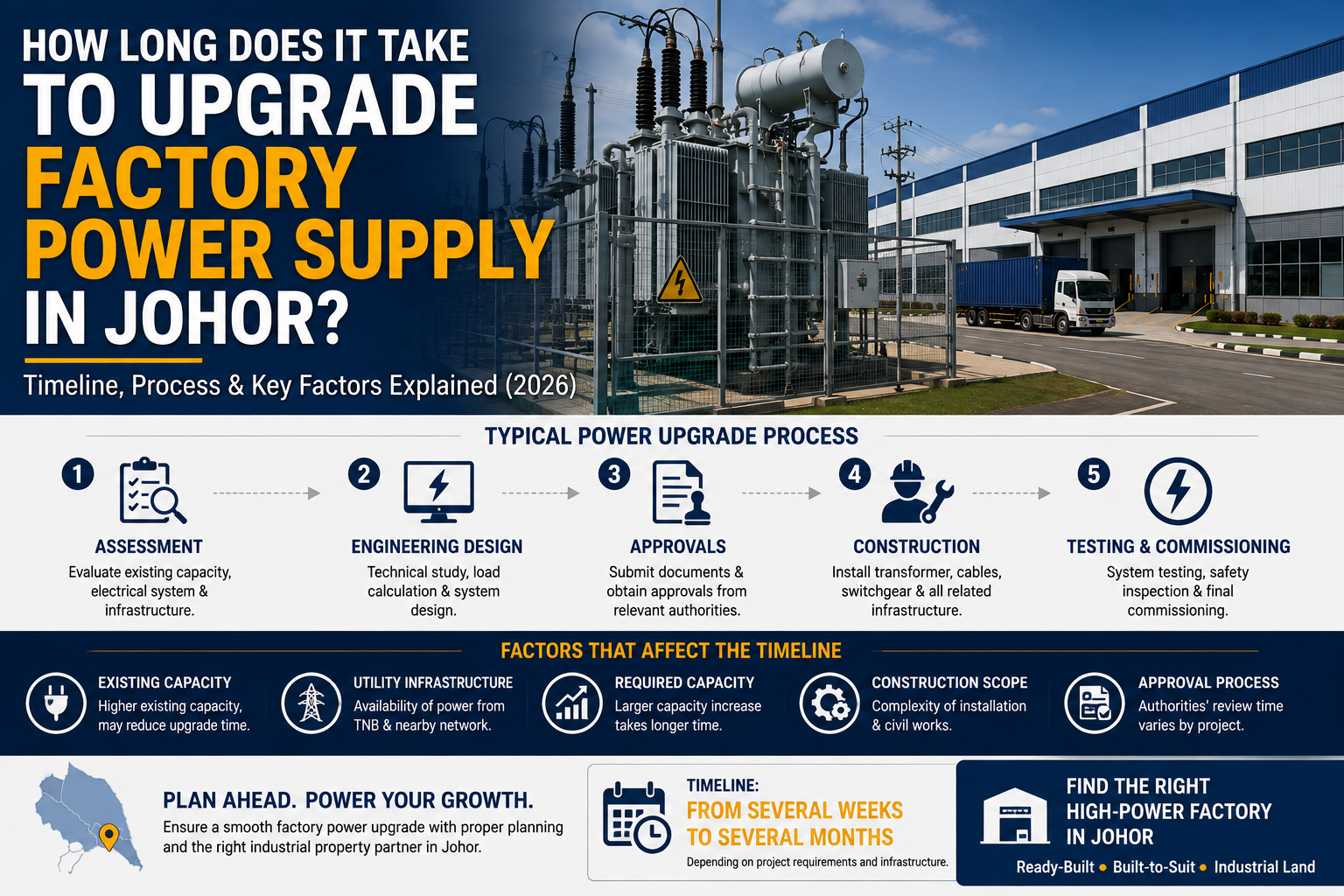
How Long Does It Take to Upgrade Factory Power Supply in Johor? Complete Guide (2026)
Introduction
As Johor continues to attract investments in semiconductors, advanced manufacturing, electric vehicle (EV) components and data centre supply chains, one of the most common questions from international manufacturers is:
“How long does it take to upgrade a factory’s power supply in Johor?”
The answer depends on several factors, including the factory’s existing electrical capacity, the surrounding utility infrastructure, the required upgrade size and the approvals involved.
Many companies assume that upgrading a factory from 1,000 Amp to 3,000 Amp can be completed within a few weeks. In reality, the process usually requires technical evaluation, engineering design, approvals and construction work before additional electrical capacity becomes available.
Understanding the process early helps manufacturers plan production schedules, equipment installation and project timelines more effectively.
Why Factory Power Capacity Matters
Modern manufacturing facilities rely heavily on stable electrical infrastructure.
Industries that commonly require higher electrical capacity include:
- Semiconductor manufacturing
- Electronics & Electrical (E&E)
- Data centre supply chain
- Battery and energy storage
- Automation equipment
- Precision engineering
- Medical device manufacturing
- Industrial machinery
For these industries, electrical capacity is often a deciding factor when selecting an industrial property.
Typical Power Upgrade Process
Although every project is different, a factory power upgrade generally follows these stages.
Step 1 – Assess Existing Electrical Capacity
Before planning any upgrade, verify:
- Existing electrical capacity (Amp)
- Existing transformer arrangement
- Main switchboard capacity
- Internal electrical infrastructure
- Available space for additional equipment
This assessment determines whether the existing installation can support the requested upgrade.
Step 2 – Technical Evaluation
The utility provider and project engineers evaluate:
- Available capacity in the local power network
- Transformer requirements
- Cable routing
- Substation capacity
- Protection systems
- Safety requirements
Additional infrastructure may be required if the surrounding network has limited spare capacity.
Step 3 – Engineering Design
If the upgrade is technically feasible, detailed engineering work begins.
Typical activities include:
- Electrical design
- Transformer sizing
- Switchgear specification
- Cable design
- Protection coordination
- Construction planning
Step 4 – Approvals and Construction
After the design phase, construction and installation work can begin.
Depending on the project, this may include:
- New transformer installation
- Electrical switch room upgrades
- Underground cable works
- Utility connection works
- Testing and commissioning
The actual timeline varies according to project complexity and the availability of utility infrastructure.
How Long Does It Usually Take?
There is no fixed timeline for every factory because each project depends on existing infrastructure, engineering requirements and approvals.
However, many larger upgrades involving new electrical infrastructure commonly require several months from technical assessment through commissioning. Projects that need new substations, extensive network reinforcement or significant construction work can take longer.
Companies planning a major expansion should therefore begin discussions as early as possible rather than waiting until machinery arrives on site.
Factors That Affect the Timeline
Several factors influence the duration of a power upgrade.
Existing Electrical Capacity
Factories that already have relatively high capacity may require fewer modifications.
Utility Infrastructure
Areas with stronger electrical infrastructure may accommodate upgrades more efficiently than locations requiring major network reinforcement.
Required Capacity
A modest increase generally involves fewer engineering works than a large jump in electrical demand.
Construction Scope
Projects requiring new transformer compounds, switch rooms or underground cable routes naturally require additional time.
Regulatory Approvals
Approval requirements vary depending on the scope of work and project location.
Who Pays for the Upgrade?
Commercial arrangements vary.
Common approaches include:
Property Owner Funds the Upgrade
The owner invests in the electrical upgrade to increase the property’s long-term value and attract future tenants.
Tenant Funds the Upgrade
The tenant pays for the upgrade when the additional capacity is required for specialised manufacturing.
Shared Investment
The owner and tenant negotiate a cost-sharing arrangement, often linked to a longer lease term.
Every agreement should clearly define responsibilities before work begins.
Ready-Built Factory or Built-to-Suit?
Companies requiring significant electrical capacity should compare both options.
Ready-Built Factory
Advantages:
- Faster occupancy
- Existing infrastructure
- Lower initial capital investment
Potential limitation:
- Upgrade flexibility depends on the existing installation.
Built-to-Suit (BTS)
Advantages:
- Designed around production requirements
- Custom electrical infrastructure
- Higher long-term efficiency
- Easier future expansion
BTS developments are often preferred by manufacturers with specialised equipment and long-term operational plans.
Questions to Ask Before Signing a Lease
Before committing to a factory, ask the following:
- What is the existing electrical capacity?
- Has the available capacity been verified?
- What is the maximum upgrade potential?
- Is additional transformer infrastructure required?
- Who is responsible for upgrade costs?
- What approvals are required?
- What is the estimated implementation timeline?
- Will the upgrade affect the target production date?
Obtaining clear answers early helps reduce uncertainty and project delays.
Why Work with an Industrial Property Specialist?
Selecting a factory with suitable electrical infrastructure requires technical knowledge beyond standard property transactions.
An experienced industrial property consultant can help you:
- Compare available high-power factories
- Assess upgrade feasibility
- Evaluate infrastructure readiness
- Coordinate with property owners and technical consultants
- Identify Built-to-Suit opportunities
- Plan long-term expansion
Professional guidance allows manufacturers to reduce risk and make better investment decisions.
Frequently Asked Questions
Can every factory be upgraded?
Not necessarily. The feasibility depends on the existing electrical installation, available utility infrastructure, land constraints and engineering requirements.
Should companies wait until signing the lease before discussing power upgrades?
No. Electrical requirements should be evaluated during the site selection process so that timelines and responsibilities are understood before commercial commitments are made.
Is a Built-to-Suit factory better for high power manufacturing?
For companies requiring substantial electrical capacity and customised production layouts, a Built-to-Suit facility may provide greater long-term flexibility. However, the best solution depends on project timing, investment strategy and operational requirements.
How long does it take to upgrade a factory’s power supply in Johor?
There is no fixed timeline. A factory power upgrade may take several months depending on the existing electrical capacity, local utility infrastructure, transformer requirements, engineering design, approvals, construction scope and commissioning requirements. Projects requiring new substations or major network reinforcement may take longer.
Who normally pays for a factory power upgrade?
The cost arrangement depends on the property and lease structure. The upgrade may be funded by the property owner, the tenant, or shared between both parties. The responsibilities, upgrade scope and costs should be agreed before the tenancy or purchase commitment is finalised.
Expert Note
Factory power upgrade requirements should be evaluated during the site selection stage rather than after a property has been committed. Manufacturers should verify the existing power capacity, upgrade feasibility, utility infrastructure, estimated timeline and responsibility for upgrade costs before finalising a factory lease or purchase.
Reviewed by Tom Chiew – Industrial Property Consultant, Johor Industrial Factory.
Last updated: September 2026.
Conclusion
Electrical capacity has become one of the most important considerations when selecting an industrial property in Johor.
The timeline for upgrading a factory’s power supply depends on technical feasibility, utility infrastructure, engineering requirements and project scope. Because these factors vary from site to site, manufacturers should begin planning early and verify all technical details before signing a lease or purchase agreement.
Whether your company requires a ready-built factory, a high-power facility or a Built-to-Suit development, understanding the power upgrade process will help reduce delays and ensure a smoother factory setup in Malaysia.
Written by Tom Chiew
Industrial Property Consultant in Johor with 14 years of experience helping manufacturers and investors find factories, warehouses and industrial land.
Pls call/whatsapp Tom 012-7622 769 more info
Email: tomchiew82@gmail.com